
A decade ago, much of what professional services firms billed for was necessary and often tedious work that didn’t need much insight: collecting documents, tying one system to another, and creating the first draft. An actual human had to get those tasks started.
AI is now quite capable of handling much of that work. A well-trained large language model can now organize a data room, flag inconsistencies, and produce a usable first cut in a fraction of the time. So, it’s fair to ask what happens to consultants when a model can do the part of the job that used to fill the timesheet.
We don’t think consulting is going anywhere. What’s changing is where the value sits, and in a way it’s where the value always was. Producing the analysis is worth less than it used to be. Knowing what it means, and being able to defend it, is worth more.
What the market shows
Spending on professional services backs this up. Mordor Intelligence puts the global management consulting market at about $375 billion in 2026, growing roughly 4.7 percent a year through 2031. Companies have not slowed down on their professional services expenditures.
Exhibit 1: Global Consulting Market Forecast
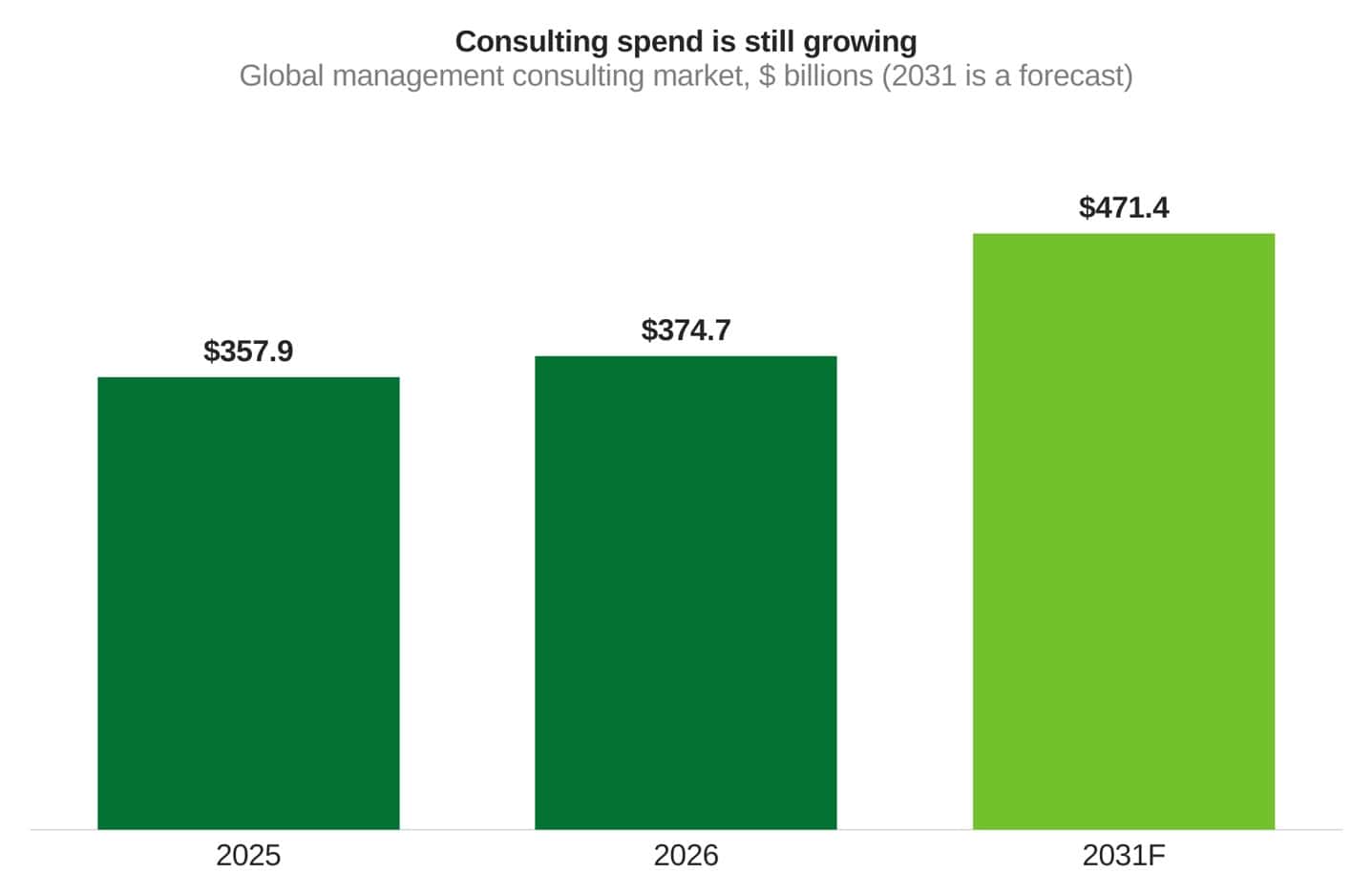
Source: Mordor Intelligence, Management Consulting Services Market.
What has moved is the time spent on various tasks. In a Thomson Reuters survey of 1,816 professionals in law, tax, audit, accounting and risk, 74 percent said they use AI several times a week. Similarly, an IDC survey of 2,275 senior finance leaders found that 48 percent spend 15 or more hours a week validating AI output. The hours that used to go into building a schedule now go into checking it.
Exhibit 2: IDC Survey of Finance Professionals
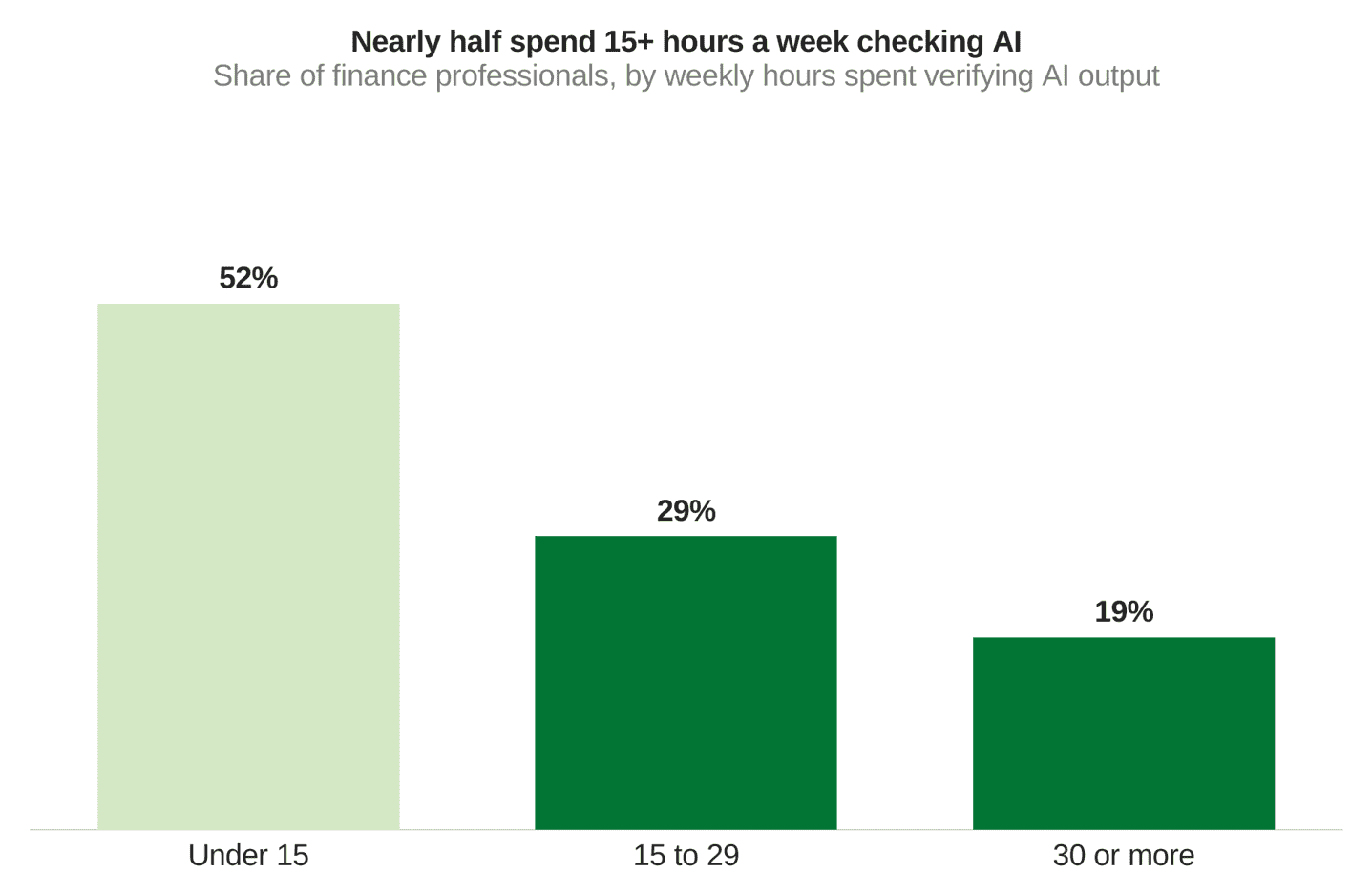
Source: IDC survey of 2,275 senior finance decision makers, commissioned by Sage (2026).
Hard to spot errors
Quality Control is essential in producing an output that can be trusted. The errors that worry us are the ones that often look right. A normalized EBITDA figure may seem reasonable but could be overstated if, for example, it adds back a rebate that was already included in revenue. Checking formulas alone will not identify that issue. Identifying it requires understanding how the company records rebates and asking management the right due diligence questions.
The bigger judgment calls work the same way. How will the other side attack an add-back? Which customers leave with the owner? Are the revenue lines sustainable? These answers come from conversations, from knowing the business, and from having seen the same issue on other deals.
Clients have also noticed this. When Thomson Reuters surveyed corporate clients about their outside firms, 78% said they consider it essential for AI to improve the quality of the work, not just make it quicker. Yet only 6% said that most or all of the firms they work with are actually meeting this expectation.
Conclusion
In our line of work, an output with no name behind it is worth very little. Numbers carry weight because a person reached them, signed off on them, and can explain them when someone leans on them. If a stakeholder pushes back on an adjustment, a model can’t stand behind its answer, but the consultant can.
Although AI can be quite effective for the first pass of a work, someone still has to check it, and that check is what most clients want. They want a person who knows where the numbers tend to go wrong to review the work, challenge the output, and stand behind the result. Clients have been paying for this all along. What they were buying was confidence that the work would hold up once someone across the table started questioning it. AI makes the work cheaper to produce, but someone still has to know whether it’s right and be willing to put their name on it.