
Discounted Cash Flow (DCF) is a valuation approach that forecasts a company’s Free Cash Flows (FCF) and discounts them to the present using a rate that reflects the riskiness of those projected cash flows. The discount rate can either be the Weighted Average Cost of Capital (WACC) if looking at the entire firm or instead the cost of equity if only valuing equity directly.
The DCF approach builds on the “Cash is King” principle to differentiate from EBITDA multiple valuation methods. It is also worth noting that DCF is an absolute valuation method, whereas EBITDA-based valuations are considered relative. Relative valuation methods are often prone to pricing distortion (based on comparable companies in a given sector) in a comparison of one company versus its peers, rather than the company’s intrinsic value.
Now, how are DCF models used? In the context of fundraising, DCFs are commonly used to determine the en bloc fair value of a business. The merit of DCFs in this case is grounded in providing a fundamentals-based estimate of what the enterprise could be worth to investors and stakeholders. For struggling businesses with low or no profitability, a DCF can also serve as an alternative valuation perspective by focusing on projected future cash flows rather than current earnings.
DCF Mechanics and Build
To build a DCF model, one must begin with projecting (typically 5 or 10 years) of revenues, expenses, capital expenditures and working capital. This forecast goes beyond a mere flat percentage increase and instead requires an in-depth understanding of the company’s economics, market and operational efficiencies. For example, revenue projections are built from the ground up, supported by drivers such as price multiplied by volume, customer count multiplied by average spend or perhaps segment-by-segment growth assumptions.
Once projections have been established, FCF, representing the liquidity available to capital providers after deductions (taxes, changes in working capital, capital expenditures), can be calculated. There are two types of FCF to distinguish at this stage, these being levered and unlevered. To value the equity, one would look at the total enterprise value (the value of the operating assets) and deduct the cash/cash adjacent and debt/debt adjacent items. The enterprise value is derived using unlevered cash flow, which treats the company as though it’s financed by a single capital source. The unlevered FCF method can be used for equity valuation directly; however, it requires assumptions for debt, which create additional volatility. As such, that is not the preferred method, and the more common way to perform equity valuation is enterprise value minus net debt.
Time value of money is now introduced beyond mapping out the 5-10 years of cash flows. This is an important concept, as a dollar today is worth more than a dollar at some point in the future due to inflation, essentially representing the opportunity cost of capital. As mentioned, the discount rate is essentially the WACC, which represents the total enterprise value of capital deployed and accounts for both the risk of that deployment and the potential opportunity cost. Determining the WACC essentially comes down to the cost of equity, the cost of debt and the weights of each.
- Cost of Equity: Calculated using the Capital Asset Pricing Model (CAPM): Risk-Free Rate + Beta * Equity Risk Premium.
- Cost of Debt: The effective interest rate a company pays on its borrowings, adjusted for the tax shield (i.e., Cost of Debt × (1 − Tax Rate)).
To capture the value of the business beyond the forecasted period, there is also a terminal value calculation, which would represent the stabilized, longer-term growth of the company into perpetuity. To summarize, the DCF valuation is the present value of both the forecasted cash flows and the terminal value calculation:
EV = Σ [FCFFₜ / (1 + WACC)ᵗ] + [Terminal Value / (1 + WACC)ⁿ]
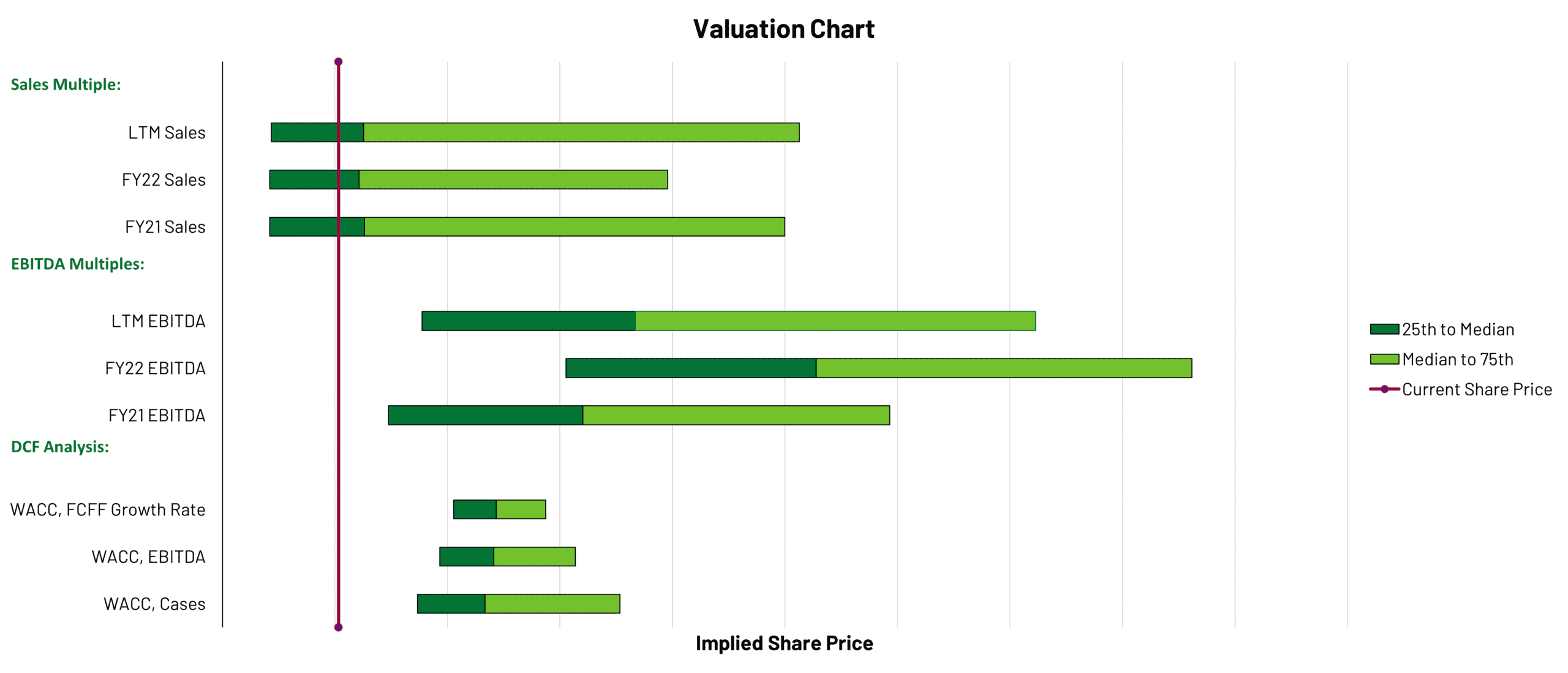
Exhibit A: A football field chart showing the implied share price ranges across multiple valuation methodologies (Sales Multiples, EBITDA Multiples, and DCF Analysis) compared against the current share price.
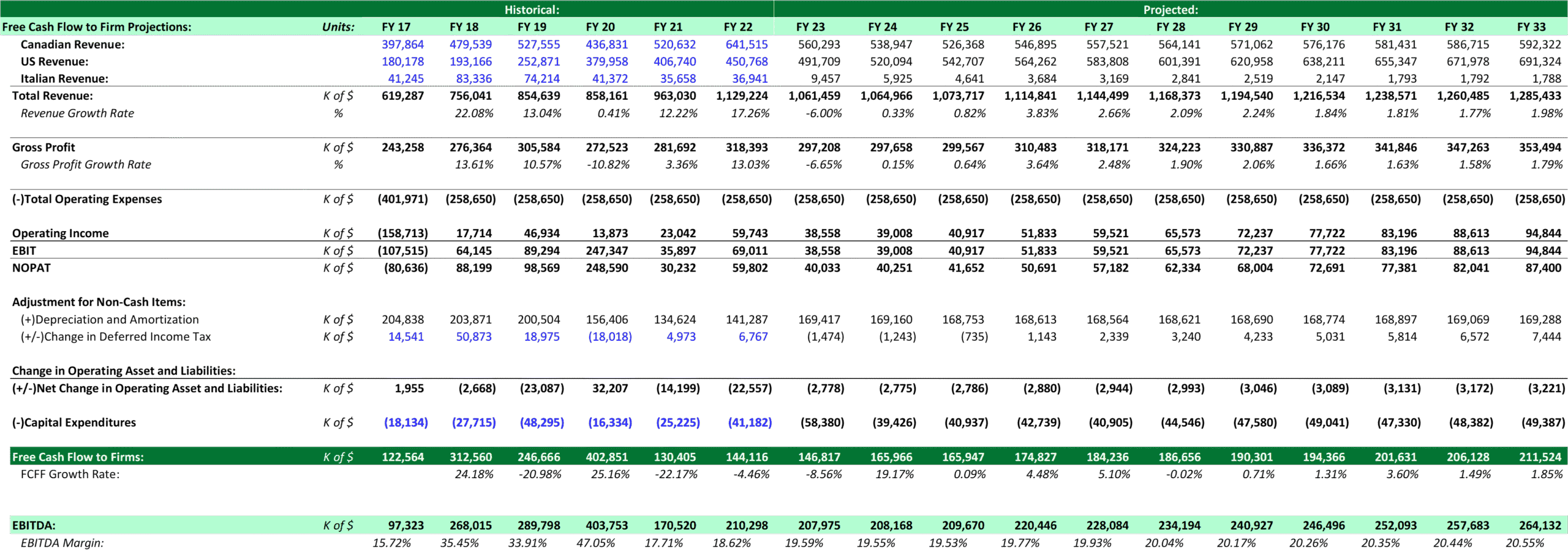
Exhibit B: An example of the projected cash flows would look like before the discounting stage.
Strategic Advantages of Intrinsic Valuation
It is fair to say that the main bargaining point for the usage of the DCF model is that it uses an innate (over relative) value. Another main benefit of the DCF as a valuation method is that it is extremely flexible in its ability to assess a variety of businesses and industries. Regardless of the company, the framework will often be the same. This isn’t without saying that building a DCF is extremely technical and requires intense financial analysis, sensitivity tests and scenario analyses to see how the valuation holds up under different conditions.
The Reality Check: Limitations and Pitfalls
Despite being a commonly used tool, the DCF is quite sensitive, as the model relies so heavily on long-term projections; even a small shift in the WACC or a minor adjustment to the terminal growth rate can result in massive changes in terms of the overall valuation. This volatility leaves room for sanity checks against market multiples to provide a holistic valuation perspective.
Furthermore, DCFs face a problem in predictability when applied to early-stage businesses or perhaps cyclical industries where revenues swing with economic cycles. In these sectors, forecasting five to ten years of cash flow may seem more like random guessing rather than educated assumptions. With unrealistic inputs, an expected value can very easily lean too far one way or the other.
There are a few approaches one can take to mitigate the limitations of DCF modelling. Analysts will use a variety of different growth, margin and discount rate estimates to test how valuations move under a range of conditions versus a single point estimate. DCF outputs are also commonly used in tandem with market-based methods (comps and precedents) to ground valuations.
DCF modelling, although extremely versatile in terms of valuation modelling, is no crystal ball. For the average PE or strategic buyer, it provides the base needed to make moves with confidence. For example, during the dot-com bubble, companies commanded valuations in the hundreds of millions despite generating minimal revenue and no clear path to profitability. A DCF analysis based on cash flows could have exposed the disconnect between the market and underlying business fundamentals. In a world of hype, the DCF ultimately keeps valuations grounded in cash, a measure that will always retain significance.